You plug something in and nothing happens. The lamp stays off, the phone just sits there, and no matter how many times you try a different plug or jiggle the cord, that outlet is just dead. It’s one of those things that makes you stop and wonder, did something burn out, is there a wiring problem, or is this something serious?
Honestly, it depends. We get this call a lot at Direct Current Inc., and after years of showing up to Utah homes for exactly this issue, the cause usually falls into one of five buckets. A couple of them you can sort out yourself in a few minutes. The others are situations where poking around without knowing what you’re doing can go from frustrating to genuinely dangerous pretty fast.
Here’s how to work through it.
Electrical Safety Disclaimer: This article is for informational purposes only. Electrical work can be dangerous. Always consult a licensed electrician before attempting repairs beyond basic troubleshooting. DC Electric’s licensed team is available for service across Northern Utah.
1. The Circuit Breaker Tripped
Nine times out of ten, this is where the answer is, and most people either forget to check or assume it couldn’t be something that simple.
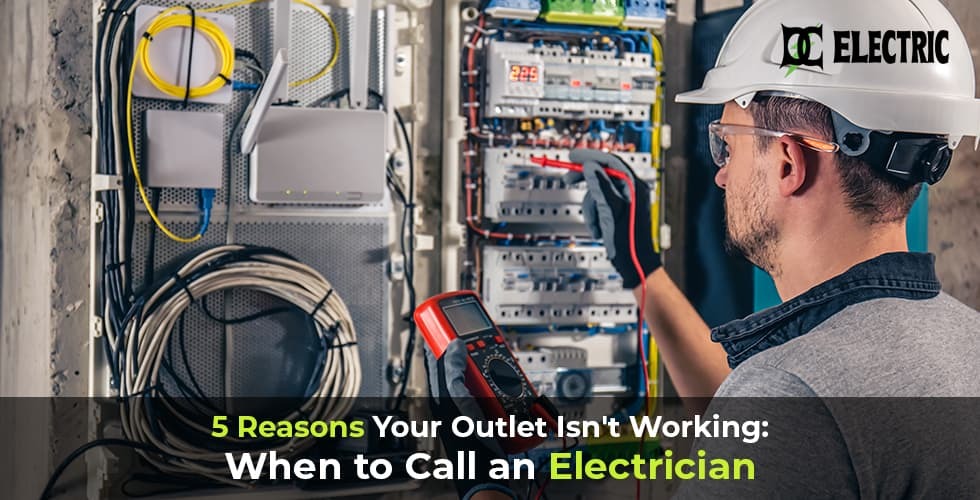
Your breaker panel is built to cut power to a circuit the moment it senses more load than the wiring can safely handle. That’s by design. When it trips, every outlet on that circuit goes dark at once, which is why you might suddenly have a whole corner of your living room or an entire bathroom with nothing working.
What to Do
Go find your breaker panel, garage, utility closet, or hallway. Look for any breaker that’s sitting in the middle instead of fully flipped to “on.” That’s your tripped breaker. Push it all the way to “off” first, then firmly back to “on.” If it snaps right back to the middle the moment you flip it, that’s telling you something deeper is going on.
When to Call an Electrician
A breaker that keeps tripping isn’t just annoying; it’s a warning. Same goes for one that feels warm when you touch it or makes a low buzzing noise. Those are signs of overloaded wiring, a short somewhere in the circuit, or a breaker that’s failing on its own. Keep resetting it, and you’re ignoring a real fire risk. Have someone from our residential electrical services team take a look before it becomes a bigger problem.
2. A GFCI Outlet Tripped Somewhere Else in the House
This one trips people up constantly, no pun intended.
GFCI stands for Ground Fault Circuit Interrupter. It’s the outlet with the two little buttons on the face, “Test” and “Reset,” and you’ll find them anywhere water is nearby: bathrooms, kitchen counters, garages, laundry rooms, and outdoor receptacles. Their whole job is to cut power the instant they detect even a tiny imbalance in current, which protects you from a shock if something goes wrong near a sink or wet floor.
Here’s the part most homeowners don’t know: one GFCI outlet can control the power to several other outlets further down that same circuit. So when a GFCI trips in your garage, an outlet in your bedroom or hallway might go dead right along with it , and those outlets don’t have reset buttons of their own.
What to Do
Walk through every room and check every GFCI outlet you can find. If one has its reset button popped out, press it firmly until you feel it click back in. Then go back to the dead outlet and test it.
When to Call an Electrician
If the GFCI pops right back out after you reset it, or if you’ve checked every outlet you can find and still can’t figure out which one controls the dead circuit, stop there. A GFCI that won’t hold a reset usually means there’s a fault in the wiring or moisture has gotten somewhere it shouldn’t. That needs a proper inspection from our electrical troubleshooting and diagnostics team, not another round of resetting.
3. The Outlet Is Tied to a Wall Switch
This one catches people completely off guard, and it’s an easy one to miss.
In a lot of Utah homes, especially living rooms and bedrooms that don’t have a ceiling light, builders wire at least one outlet to a wall switch. The thinking is straightforward: give the homeowner a way to turn a floor lamp on and off from the door without needing a ceiling fixture. Makes sense. But if nobody told you that when you moved in, a perfectly functional outlet looks totally broken because it’s just off.
What to Do
Before you assume anything is wrong, flip every switch in the room , including the ones you never use or assumed were for something else. Do it while something is plugged into the dead outlet so you’ll know the moment power comes back.
When to Call an Electrician
If you want to convert that outlet from switched to always-on, which most people do once they figure out what’s happening, that’s a wiring change best left to a professional. It’s not complicated, but getting the connections wrong creates problems that aren’t obvious right away and can cause issues with other outlets on the same circuit.
4. A Loose Wire or Backstab Connection Let Go
This is the one that’s hardest to catch from the outside and the one most likely to cause real damage if it goes unaddressed.
When an outlet is installed, the wires inside the box have to connect to it somehow. The right way is to loop the wire around a terminal screw and tighten it down so it can’t move. The faster way, which a lot of builders and contractors have used over the years, is called a backstab connection. The wire just gets pushed into a hole on the back of the outlet and held there by a small spring. It’s quick. It’s also not reliable long-term, especially in older Utah homes where the house has settled, shifted, or dealt with decades of vibration.
When that spring loses its grip, or when a screw terminal works itself loose over time, the outlet stops getting power. No burning smell, no tripped breaker, no warning at all. It just goes dead one day.
What to Do
Nothing, on your own. This one is not a DIY fix. The wiring inside that box is live unless you’ve shut off the correct breaker, and even with the power off, knowing which wire goes where and how to properly reconnect it requires hands-on electrical experience.
When to Call an Electrician
If you’ve already ruled out a tripped breaker, a GFCI issue, and a switched outlet, and only one specific outlet is dead, loose wiring is almost certainly what you’re dealing with. Our electrical repair and inspection services include a full look at the outlet, the connections inside the box, and the rest of the circuit, so we’re fixing the actual problem, not just the symptom.
5. The Outlet Itself Is Worn Out or Damaged
Outlets don’t last forever. Most residential outlets are rated for around 15 amps and somewhere in the range of 10,000 plug cycles, but in a busy kitchen, home office, or living room, that adds up faster than you’d think. Over time, the metal contacts inside the outlet wear down, the spring tension loosens, and the outlet gets to the point where it either doesn’t grip a plug properly or stops conducting electricity altogether.
Outlets in older Utah homes, especially anything built before the 1990s, may also have wiring configurations that don’t meet current National Electrical Code (NFPA 70) standards. On top of normal wear, outlets can take internal damage from a voltage spike, an overheated appliance, or a fault elsewhere on the circuit.
What to Do
Look at the outlet face closely. Discoloration, scorch marks, a burning smell, or a cracked faceplate are all signs the outlet has sustained real damage. If the wall plate feels warm when nothing is plugged in, that’s a serious red flag.
When to Call an Electrician
According to CPSC electrical safety guidance, any outlet showing heat, scorch marks, burning odor, or discoloration is a potential fire hazard. Don’t keep using it. Turn off the breaker for that circuit and get someone out to look at it; don’t wait on this one.
Warning Signs That Mean Stop and Call Right Now
Most dead outlets are inconvenient. Some of them are genuinely dangerous. If any of the following are present, stop troubleshooting immediately and call a licensed electrician:
- Burning smell near an outlet or coming from inside a wall
- Scorch marks or discoloration on the outlet face or cover plate
- Sparking when plugging a device in
- A warm or hot outlet with nothing plugged into it
- Flickering or dimming lights on the same circuit
- A breaker that keeps tripping back off
- A mild shock felt when touching the outlet or plugging something in
These are signs of arcing, failing wire insulation, or a damaged connection inside the wall , all of which are fire hazards. They need a professional inspection, not another reset.
Quick Troubleshooting Checklist: DIY vs. Call an Electrician
| Issue | DIY Safe? | Call DC Electric? |
| Tripped circuit breaker (first time) | Yes | Only if it keeps tripping |
| GFCI outlet that needs a reset | Yes | If it won’t hold after resetting |
| Switched outlet you didn’t know about | Yes | To convert it permanently |
| Loose wiring inside outlet box | No | Yes, always |
| Worn or damaged outlet | No | Yes, always |
| Burning smell, scorch marks, sparking | No | Yes, immediately |
When It’s Time to Call DC Electric
If you’ve worked through the checklist above, checked the breaker, looked for a tripped GFCI, and tested the light switches, and that outlet is still dead, it’s time to bring in someone who can actually see what’s going on inside the wall.
At Direct Current Inc., our licensed electricians work with Utah homeowners across Northern Utah every day on exactly these kinds of problems. Whether it’s a single dead outlet that turned out to be a loose wire or a pattern of electrical issues that have been building for a while, we diagnose it accurately, explain what we found, and fix it the right way.
Electrical issues that keep coming back, or that come with any of the warning signs listed above, aren’t something worth sitting on. Submit a service request or call us directly and we’ll get someone out to take a look.
Direct Current, Inc. is a licensed electrical contractor serving Sandy, Utah and the surrounding Northern Utah area. All electrical work is performed in accordance with the National Electrical Code (NFPA 70) and Utah Division of Occupational and Professional Licensing (DOPL) requirements.