
You’re sitting in your living room on a hot Utah afternoon, the air conditioner kicks on, and for a split second, your lights dim. Maybe it happens once and you forget about it. Maybe it’s been happening for weeks, and now you’re starting to wonder if something is actually wrong.
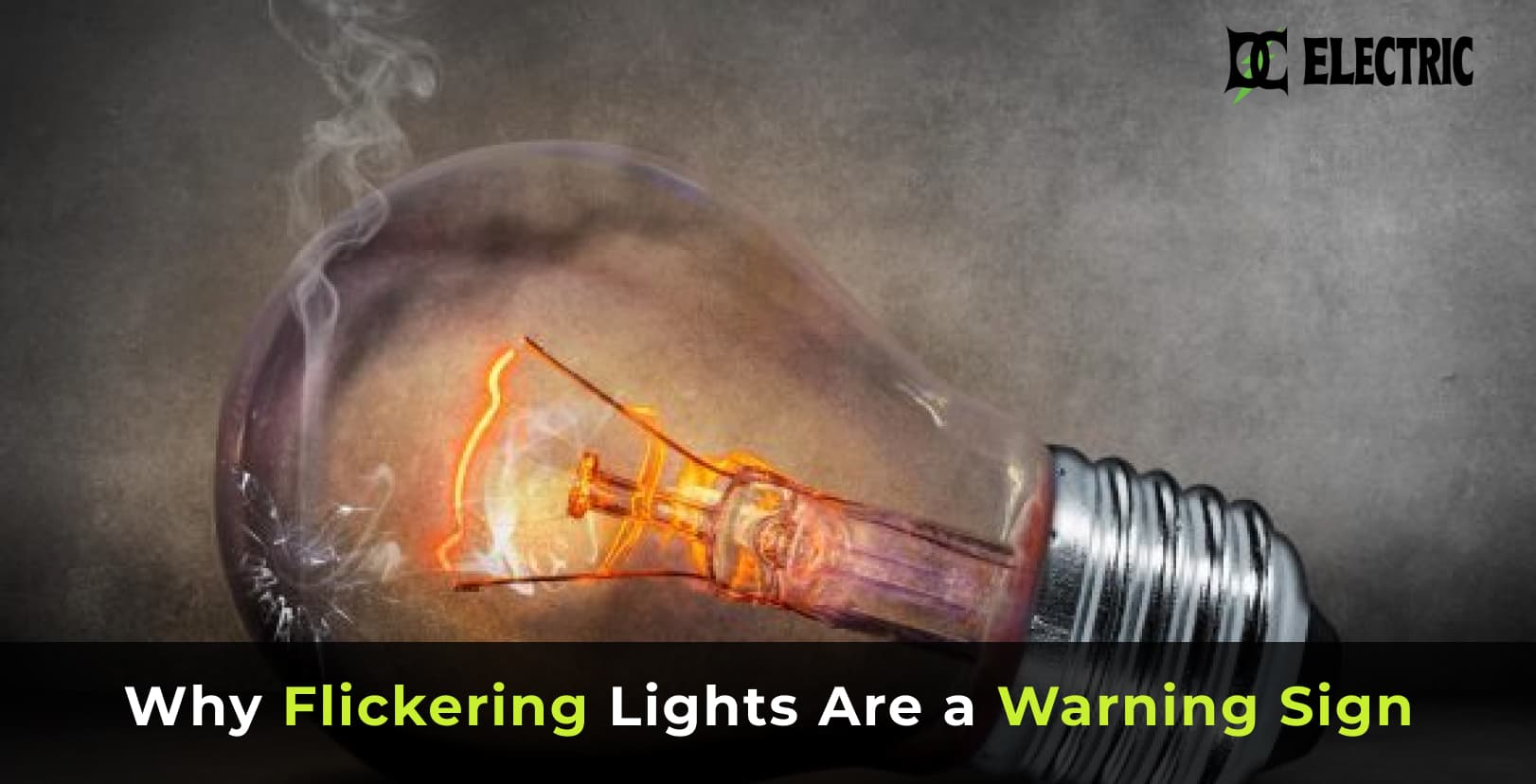
Flickering lights in a house are one of those problems homeowners often ignore until they can’t anymore. Occasionally it really is a loose bulb. Other times, it’s an early sign of an electrical fault that shouldn’t wait. Here’s how our licensed electricians at Direct Current, Inc. tell the two apart on service calls across Northern Utah and what you should do about it.
What Causes Flickering Lights in Your House?
Flickering can come from something as small as a bulb that isn’t screwed in tight or from something buried inside your electrical panel. Before you assume the worst, it helps to know what’s actually going on behind the wall.
A Loose or Faulty Light Bulb
This is the most common cause and the easiest to rule out. LED bulbs in particular can flicker if they aren’t fully seated in the socket, if they’re on a dimmer switch that isn’t LED-compatible, or if the bulb itself is simply wearing out. If only one fixture flickers and a different bulb fixes it, you’ve found your answer.
Overloaded Electrical Circuits
If your lights dim the moment the air conditioner, microwave, or hair dryer kicks on, you’re likely watching an overloaded circuit in real time. Large appliances pull a heavy wattage load, and older circuits weren’t always sized for the appliances we run today. While it can be annoying, the flickering is also a sign that your electrical panel may need a closer look.
A Faulty Light Switch or Fixture
Yes, a bad switch can absolutely cause flickering, and so can a worn-out fixture connection. Over time, the internal contacts in a switch wear down and stop making a clean connection, causing the light to flutter even when nothing else in the house is running.
Loose Wiring or a Bad Neutral Wire Connection
This scenario is where things get more serious. A loose neutral wire connection, whether at the panel, a junction box, or a fixture, can cause flickering throughout multiple rooms, not just one. Loose connections generate heat and, in some cases, electrical arcing, which is a genuine fire risk rather than a cosmetic annoyance.
Voltage Fluctuations
Sometimes the flicker isn’t about your wiring at all; it’s about voltage stability. A failing voltage regulator or an imbalance somewhere in the system can cause lights across the house to dim and brighten in a way that feels random.
Old or Aluminum Wiring
Homes with aluminum wiring, common in properties built decades ago, are more prone to loose connections over time because aluminum expands and contracts differently than copper. The Consumer Product Safety Commission has flagged roughly two million U.S. homes built with aluminum wiring between the late 1960s and early 1970s as carrying this exact risk. If your house hasn’t been rewired in a long time and the flickering has gotten worse recently, the age of the wiring is worth ruling out.
Utility Company or Meter Issues
If every light in your house flickers at the same time, even those on different circuits, the problem may be outside your home. A problem with the utility line, a loose connection at the meter, or a fluctuation from the utility company itself can cause whole-house flickering that no amount of bulb-swapping will fix.
Loose Bulb or Serious Danger? A Quick Reference Checklist
Not every flicker deserves a panicked call. Use this as a starting point, not a final diagnosis.
Likely just a minor fix:
- Only one bulb or fixture flickers
- The flicker started right after you installed a new bulb or dimmer
- Replacing the bulb solves it immediately
- The flickering is occasional and not tied to a specific pattern
Could point to a real electrical problem:
- Multiple rooms or the whole house flickers together
- The flicker happens every time a large appliance turns on
- You notice a burning smell, buzzing sound, or warm switch plate
- The problem has been getting worse over days or weeks
- Lights flicker even when nothing else is running
Warning Signs You Should Never Ignore
Some flickering is cosmetic. Some of your electrical system is telling you it’s struggling. Here’s when to stop troubleshooting and start taking it seriously:
- A burning or “hot plastic” smell near an outlet, switch, or the panel
- A buzzing or crackling sound coming from a fixture or wall
- A switch plate or outlet cover that feels warm to the touch
- Flickering that happens even when the breaker hasn’t tripped
- Sparks, discoloration, or soot marks around an outlet or switch
If you’re seeing any of these alongside the flickering, it’s not safe to leave the lights running while you decide what to do next.
Home Electrical Fires by the Numbers
This isn’t a hypothetical risk. National fire and safety agencies track these incidents every year, and the data makes it clear why flickering shouldn’t be waved off as harmless.
| Statistic | Figure | Source |
| Average annual U.S. home fires caused by electrical distribution/lighting equipment (2019–2023) | ~31,650 fires/year | NFPA, Home Structure Fires report |
| Average annual deaths from these fires | 430 | NFPA |
| Average annual injuries from these fires | 1,300 | NFPA |
| Average annual direct property damage from these fires | $1.6 billion | NFPA |
| Share of all home fire deaths caused by wiring and related equipment | 5% | NFPA |
| U.S. home fires started by arcing faults (loose or damaged connections) each year | 28,000+ | CPSC, cited via ESFI |
| Annual property damage from arcing-fault fires | $700 million+ | CPSC, cited via ESFI |
| Fires each year involving electrical receptacles specifically | 5,300 | CPSC |
| Deaths each year from receptacle-related fires | 40 | CPSC |
| Share of electrical fires AFCI devices could prevent, per CPSC estimates | 50%+ | CPSC |
NFPA’s most recent five-year analysis found that electrical distribution or lighting equipment caused an average of 31,650 home fires a year, resulting in 430 deaths, 1,300 injuries, and $1.6 billion in direct property damage annually. Wiring and related equipment alone accounted for 3 percent of all home fires but 5 percent of home fire deaths. Separately, arcing faults are responsible for starting more than 28,000 home fires a year in the U.S., causing hundreds of deaths and injuries and over $700 million in property damage, while the CPSC reports that electrical receptacles alone are involved in 5,300 fires annually, causing forty deaths and more than 100 injuries.
How to Safely Check Flickering Lights Yourself
Before you call anyone, there are a few safe checks a homeowner can do:
- Check the bulb first. Turn off the light, remove the bulb, and make sure it’s seated properly. Try a different bulb if you have one on hand.
- Note where it’s happening. Is it one fixture, one room, or the entire house? This detail matters more than almost anything else when diagnosing the cause.
- Watch for patterns. Does it happen when a specific appliance runs? Write it down. That pattern is useful information for a technician.
- Check your breaker panel from the outside. Look for a breaker that feels warm or shows any visible damage. Do not open the panel cover or touch internal components yourself.
- Stop if you smell anything unusual. If there’s any burning smell or visible damage, skip the troubleshooting and turn off power to that circuit at the panel.
None of these steps require opening walls or touching wiring, and that’s intentional. The moment a fix requires accessing wiring, a panel, or a fixture’s internal connections, it’s a job for a licensed electrician.
When to Call a Licensed Electrician
If you’ve gone through the checklist above and the flickering is still happening, especially if it involves multiple rooms, gets worse over time, or comes with any warning sign like a smell or a buzzing sound, it’s time to call a professional. This is also true if the flickering started after a storm, after the utility company did work nearby, or if your home still has its original wiring from several decades ago. Our Service Department handles exactly this kind of diagnostic work, tracing the issue from the fixture back to the panel until we find the actual source.
Related Electrical Problems Worth Checking
Flickering lights rarely show up in isolation. If you’ve also noticed an outlet that’s stopped working in the same part of the house, it’s worth checking both issues together, since they can share the same root cause somewhere in your circuit. We’ve written a separate guide on what to do when an outlet stops working, that pairs well with this one if you’re troubleshooting more than one symptom at a time.
When to Call DC Electric
Flickering lights are easy to explain away until the day they aren’t. If you’ve run through the checklist and you’re still unsure, or if any of the warning signs above apply to your home, it’s worth having a licensed electrician take a look before it turns into something bigger. Our team serves homeowners across Northern Utah and handles everything from a quick diagnostic to a full panel upgrade. Visit our residential services page to see how we can help, or contact us directly to schedule a technician.